CP Executive train in Albany

CP Executive train in Albany

Tuesday, July 27, 2021

Shay in Croghan, NY (2014)

Most of this week will find me up at a rustic cabin in Chaumont, NY, which is in the Thousand Island's region of the state. I go there once a year with a group of guys to play non-stop board games. Some games last 12 hours or more, and sometimes we might play several dozen shorter games. I frequently car pool with a friend who is a closet model railroader. He owns model trains, likes to go to train shows, has a basement, and belongs to the Union Pacific society... but doesn't have a layout! (He has kids, and would rather have a workshop, and wants a game room). 

There are times during the drive up when we parallel railroad tracks. On the Mohawk, Adirondack & Northern line I will frequently see endless strings of covered hoppers being stored. However, there isn't much to see on the (former?) Lowville and Beaver River RR line. Except a shay. 

A shay? In upstate New York? Yup, and right out in the open for anyone to see. In 2014, my friend and I detoured on the way through Croghan, NY, which is about ten miles northeast of Lowville and about 30-40 miles east of Watertown.

What's the shay doing there? According to the Railway Historical Society of Northern New York's website, the L&BRRR is owned by the Genesee Valley Transportation group of shortlines based in Batavia, NY. The shay, which belong to a Livingston Lansing, was donated to the RHSNY upon his death. Though the website mentions that an enginehouse was built for it, it has been outside for many years now.

Per the same website, the RHSNNY owns the Depot and plans to operate limited passenger service out of Croghan along the Lowville and Beaver River Railroad, one of the oldest operating shortlines in America. A vast collection of North Country railroad memorabilia and artifacts is on display at their museum.

Here is the interesting side of the shay. I have seen several 1/8 scale models operate, and even wrote an extensive article in a live steam magazine about them. I have several different sets of plans for them too, should I sometime decide to build one.

This is what the inside of the cab looked like.

To give perspective of how easy it is to access and photograph the engine, an apartment complex is shown in the background on the left. How cool would it be to live with a shay right outside your window?

The rear of the shay, with the sandbunkers on the back of the water tank.

Also on display was a snow plow. 

I have no idea if this engine will ever run again, but likely not in its current location. As a shay that presumably operated in New York State at one time (and that likely makes it the last one surviving) something should be done to preserve it for the future instead of letting it sit outside in the elements.

Recent online satellite pictures show that the engine and plow have been moved a little (it looks like the shay was pulled out and then backed in front of the plow, though I don't know why). As an aside, there was an article online about a start-up tourist train that was proposing to be based on Lowville. I wish them well.

Saturday, July 24, 2021

D&H train on Cohoes Bridge (1984)

Here is a shot from my collection of the D&H bridge in Cohoes, dated 4/07/1984. I actually had plans last year to try and take a picture of a current CP train on the bridge in the same position that this train was in, but it was a horrible failure. From what I can tell, the entire consist is Boston & Maine engines (including the lead engine, which appears to be a former all-black Penn Central patch out?) 

Perhaps this fall I can get back and try it again.

Tuesday, July 20, 2021

Staying at the Bridgeview Bed and Breakfast

Typically on my birthday I do something train related, and this year I hoped to spend the weekend at the Bridgeview Bed and Breakfast which is located just outside of Harrisburg, PA. It is situated literally where it is surrounded on several sides by busy railroad tracks, and overlooks the Susquehanna River (and a railroad bridge crossing it). I first became aware of this BNB after seeing an advertisement for it in a Trains magazine my sister-in-law gave me for Christmas. I tried to reserve one of their "best rooms" (the ones with the best views of the bridge) for Memorial Day but they were booked solid. However, I noticed that my wife's birthday fell on a Saturday in June and she always wanted to go back to Hershey Park, PA. So, a trip here seemed like it would allow us both to have a good time. Of course, I didn't mention where we were staying until the day before the trip.

We only had the weekend but I took Friday off from work, so we would have plenty of time on the drive down to explore other places too. Most importantly, I didn't want this to become a "railroad-themed" trip and wanted to do things my wife would enjoy too. Upon arriving at the BNB, I heard a train and immediately ran to the deck to take some pictures. As you can see, they have a lovely (this picture only shows 1/3 of the deck) porch to watch the trains and the Susquehanna River.

Sadly, it was rainy on Friday and Saturday evenings, causing me to watch the trains from inside for the most part. Some odd cloud and weather led to interesting pictures though.

As was shown on the satellite map above, the tracks surround the BNB on several sides. And they are very close. Observe the NS train passing on the other side of the building. It is partially hidden in the trees.

The name of the program escapes me, but there were television screens inside and out showing in real time the locations of trains approaching the bridge on a schematic display board. The red lines are where actual trains are, and the green lines show train routes that have been cleared. The Bridgeview BNB is in the very center of this map. 

Considering I was away for most of Friday and Saturday evenings, and also left around 10AM on Sunday morning, I estimate I saw at least 20 trains. There were many more I heard while lying in bed getting ready to sleep. None kept me up during the night. 

By the end, I didn't bother running to the window. It was cool to see so many, but most were Norfolk Southern and looked the same after a while. Two Amtrak trains pass during the mid-day but aside from that it is mostly NS. 

In all, it was a fun trip. I also fit in miniature golf, a day trip to HersheyPark which included a live-steam train ride and their water park (great on a 96-degree day), a visit to a restored Japanese house and garden, the Philadelphia Zoo, a Philly cheesesteak, a train store, and more. All in one weekend. I can't wait to go back!

Friday, July 16, 2021

Roundhouse "Lady Anne" gauge 1 live steamer

I have a passion for British steam locomotives, especially narrow-gauge ones. They are short, chunky, and frequently colorful. Roundhouse Engineering has been making 1/19 scale live steam locomotives since 1982, and the "Lady Anne" model was right there at the beginning. I have wanted one for many years... at least 15 if my old catalogs are any evidence of this.

After some very poor results with an Accucraft Ruby kit, I decided I had enough messing around and ordered a proper Lady Anne from Roundhouse during the summer of 2019. By the way, "Lady Anne" is the name of the model and as my wife's name includes "Anne" I am keeping it named as is. My engine was ordered in maroon, a color that is probably their most recognized for this model, though I custom ordered mine with a gloss black smokebox. This is how they used to come from the factory, but lately the smokeboxes are painted matte black and I wanted mine to match the model I dreamed about for years. The dome is also painted maroon to match the body but I recently ordered a plain, brass dome which is what they used to come with. 

I haven't been up to the Adirondack Live Steamers lately due to my illness and the pandemic, but this past weekend was Family Day and I thought it was a great time to try her out. They are already tested extensively at the factory upon assembly, but I had never run one before so I was a little apprehensive. I shouldn't have been. She performed well, though I frequently had the gas burner too high and produced wasteful amounts of steam. I will need to learn how to fire her properly, which likely means turning the gas burner down really low once pressure is up. My train consisted of three modified New Bright train set cars and one LGB car. Proper coaches are likely a winter project for next year.

She took two years from order placement to delivery, and along the way there was a mistake but it was easily corrected. And now I am very pleased with her.

I also took my Boston & Maine "Bluebird" engine for a spin (featured in the Jan/Feb issue of Live Steam & Outdoor Railroading magazine) and she ran really well. 

Overall, it was a very pleasant way to spend a Saturday afternoon.

Monday, July 12, 2021

Rome & Fort Bull Railroad (1980s)

Pop Quiz: name a two-foot gauge steam railroad that operated in upstate New York within the past 20 years? If any of you answered the Rome and Fort Bull Railroad, you would have been correct! It was a park ride that operated in the old Erie Canal Village in Rome, NY. I went there once or twice when visiting my grandparents who lived in Utica, and distinctly remember the train. It was an actual live steam locomotive, not a gas-powered engine dressed up to look like a steamer, and the track plan featured a straight run with return loops at each end. The pictures are from 1987 and 1988.

Based on internet research, it appears that in the last fifteen or so years of operation it had a 2-6-2 steamer, an 0-4-0 steamer, a Chance brand CP Huntington steam-profile diesel engine, and then an actual Plymouth diesel engine pull the train. 

This is a picture of me (the tall one with my blonde hair) and my brother when we rode the train in September 1987. Is it any wonder that I am still fascinated by both steam trains in general, and 2-foot gauge trains in particular?

Here is a better shot of the engine, now with my sister included. It is named the "Edward J. Nolan", and information found at a link below indicate that he built the engine originally in 15" gauge for his private track. 

If the chassis was rebuilt into a 24" gauge ride that would explain why the recycled drive and bogie wheels are so tiny compared to the rest of the engine. It almost looks toyish.

Ironically, in the picture below my brother seems more excited than I am to be on the train, but if you look closely I appear to be studying the couplers connecting the cars on the train. I have always loved staring at train details such as this and find it relaxing. 

Here is a nice shot showing the water tower. I imagine that they actually used it to fill the tender with water.

Here is a satellite image of the site, and the red lines I added are where the tracks ran. It was quite a nice set-up. As a kid I remember thinking that the switches were likely sprung on the return loops.

This last picture is from a 1970s-era postcard, and note that the cars don't have roofs.

Sadly, the Erie Canal Village has been shut down for many years and the whereabouts of the train itself are unknown. There are attempts to bring back the site as a historic place to visit, but the train tracks were pulled up and the trains taken away. However, this online board thread has some information regarding the whereabouts of the train equipment. Hopefully, someday... somewhere... they will operate again.

Thursday, July 8, 2021

D&H Geep #573 in Portland, ME

I haven't done much modeling lately because I have been working on a new kitchen floor for the wife. It has taken away a lot of my free time, and the summer heat (which I hate... give me snow any day) kills my desire to do anything but crash on the couch and read train books. 

But, I still run into neat pictures and here is one from July 03, 1984 in South Portland, Maine. It has D&H high-nose GP-7 #573, one of the very few first-generation geeps actually painted or lettered for the D&H. More information about her can be found here and here.  

Look at all the steam and/or smoke the engine is putting out. I don't think those are clouds in the background, but I might be wrong. Anyway, coupled with a B&M Geep it is making good progress with a mixed freight. And look at the condition of that track on the left of the mainline!

Sunday, July 4, 2021

Happy Fourth of July!

Happy Fourth of July! As promised last year, I am posting pictures of my favorite steam locomotive painted up for our nation's bicentennial scheme in 1976. The Arcade and Attica Railroad decided to spruce (?) up Baldwin #14 with highlights in red, white and blue. Of course, there was the already-standard orange lettering on the tender sides.

Note the color of the handrail on the smokebox front, the blue coupler cut lever ends, the red foot steps on the pilot, and the blue and white lining on the boiler side walks. 

The tender coupler cut levers and steps were also painted, too. The blue isn't as visible in the picture below, but the handles are indeed blue.

Quite colorful, though it didn't last very long. I think by 1977 #14 had been repainted into more "traditional" (at least for the A&A) colors. Perhaps that is a good thing. Still, I love that this little railroad decided to participate in the bicentennial hoopla.

And here is #14 in my personal favorite scheme- black and yellow. Most people don't think of it as attractive, but since that was how I saw it as a child that is what my memories are of. Here she is in 1986:


Wednesday, June 30, 2021

Utica's Union Station

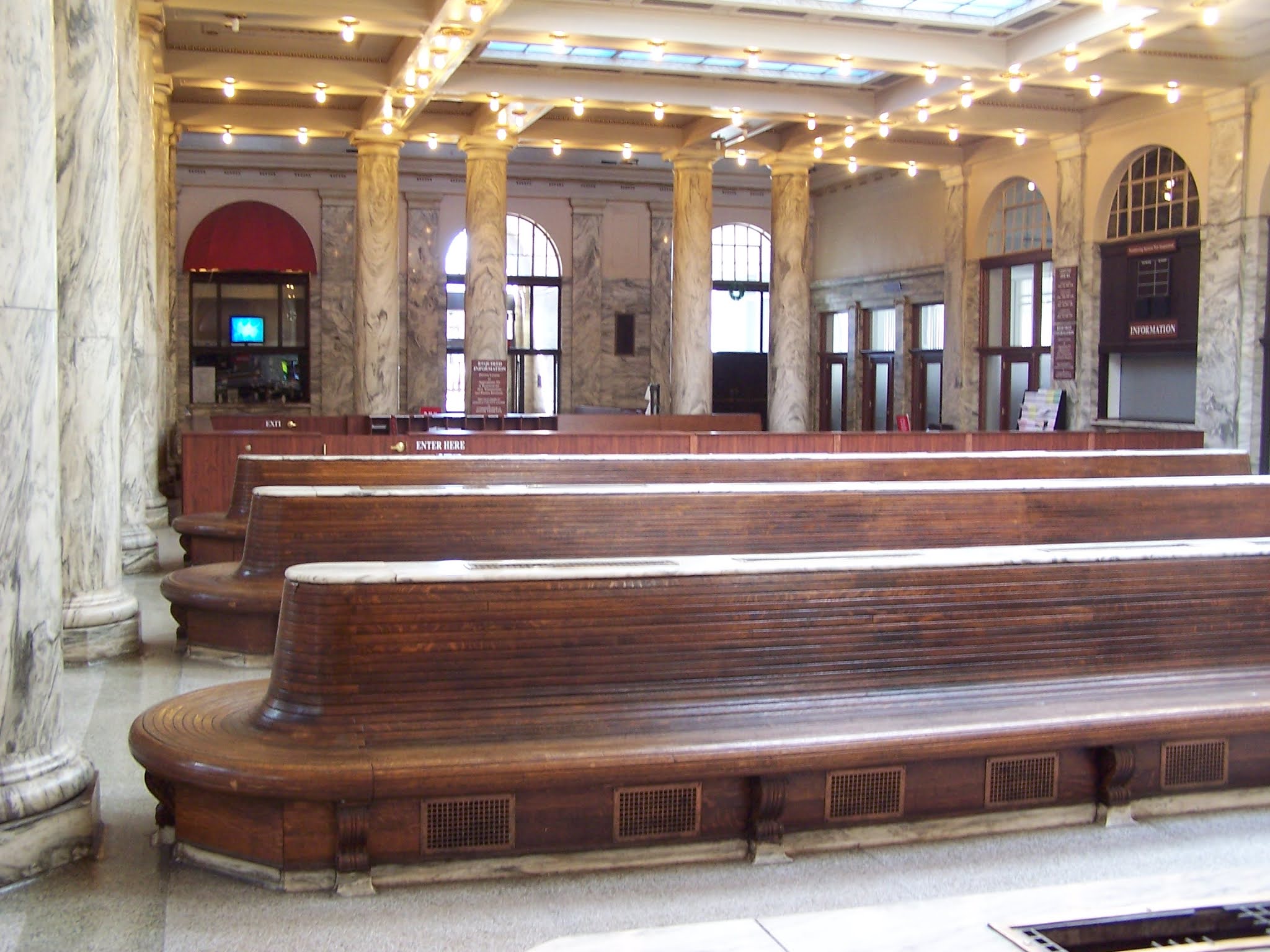
As mentioned previously, the old NYC Union Station in Utica, NY has a special place in my heart. I have been there dozens of times over the years, and literally stop there every time I go to Utica to visit family. Holidays... birthdays... even funerals all involve a stop at the station first. The pictures below are from March 2005.

It is an imposing structure, and per Wikipedia was built between 1912-1914 in the Italian style. It is currently registered in the National Register of Historic Places. Originally it served 14 tracks via 8 platforms, and they were all linked by an underground tunnel system.

When I first went there in the 1980s, it was a run-down hulk of a building. Decay was everywhere, portions were closed off and weeds choked some of the unused stub tracks. Though restoration had began in the late 1970s, there evidently was a lot remaining in the 1980s. Still, I was impressed by the marble columns and the odd-looking long wooden benches that seemed to go on forever. It looked nothing like the Rochester Amtrak station and I was in awe.

And then things changed for the better. I don't know the timing of everything, but the Adirondack Scenic Railroad moved in and the City of Utica decided to put some of their municipal offices inside. A restaurant, a barber shop, and a tiny hobby shop also rented space. 

The best part of this revitalization was the overhead connecting bridge that spanned the east-bound mainline track. It was open to the public and offered good views of the MA&N train yard (looking north) and the NYS&W yard (looking south). The pictures below are from August 2005

The first shot is of the Mohawk, Adirondack & Northern shortline's yard. I remember as a kid seeing it filled with flatcars loaded with pulpwood, though now it mostly stores empty covered hoppers. The blue engine house looks like a model from Pikestuff.

Further east is the old Conrail tower. It was abandoned by the time I saw it in the 1980s, but I am glad it is still standing today. The coaches in the foreground belong to the Adirondack Scenic Railroad, which will be the subject of another post sometime.

Can you imagine what it was like to have 14 tracks busy with passenger and freight trains? Now, it is all just a torn-up yard. I believe it is the Central New York Chapter of the National Railway Historical Society that offers a beautiful print of a picture of this station showing it in its heyday. Here is a photograph of the painting by Larry Fisher that I took during a train show. Here is the link to purchase a print of it.

And what it looks like now:

This is a shot from the pedestrian bridge looking East. There is an expressway that parallels the tracks in that direction, and many a time I would see automobile headlights in the distance and think that it was an approaching train's ditch lights.

These former Conrail camp cars were likely here for decades. As a kid I always wondered what they were for. They looked like mobile homes on wheels. 

Utica Station is located on the busy Water Level Route connecting Chicago with NYC, so lots of different trains pass through every day. And foreign power is not only possible, but expected. The pictures below are from April 2016.

Other times, all you see is a rail truck. 

Still, this place has special memories for me. When I go to visit my grandmother for Sunday dinner, she knows that my first stop will be here. Usually, Amtrak had an eastbound train arriving around 12:15 and a westbound at 11:40 so getting there around noon meant I would see at least one of them. With Amtrak's new Covid schedule changes, though, I am not sure.

Hopefully I can ride the Adirondack Scenic Railroad soon, and revisit this grand station once more!

Sunday, June 27, 2021

Train Troll WW&F flatcars

For the past couple of weeks I have been working on a pair of Train Troll WW&F flatcar kits, and I decided to build them both at the same time to economize my efforts. 

They are laser cut wood kits, a first for me, but they seemed simple enough. Both kits are basically the same, but one includes some boards to convert one car into a low-sided gondola.

The frame was built up from several pieces that glued onto each other, and as each new part was added I applied weight to prevent anything from warping. Honestly, I don't know if that is required with a laser cut wood kit but it was easy to do now and I figured it would be hard to fix later.

T

The prototype defunct WW&F had similar flatcars, but I wanted to build and decorate my models so that they looked like two flatcars currently at the WW&F museum in Alna, Maine. Those cars are slightly (2 scale feet) longer then the kit's dimensions, and the graphics are different. Still, these cars were better options than trying to rework Bachmann On30 cars. Unfortunately, one glaring detail in the kits that doesn't match the current museum cars is the number of stake pockets on the sides. The kit has 6 per side, whereas the prototype has 8 and the 2 middle ones are close together. Because fixing this would have meant sourcing more stake pocket castings, filing the holes pre-burned into the sides, and then drilling new holes... too much work... I left it as is. 

The ends of the cars have extra nut/bolt/washer castings where the tie-rods would come through. These rods, as well as some other details, were actually included in the kit. Installing the n/b/w casting was an exercise in frustration because they were so small and most of the shaft had to be cut off, leaving little to actually fit into the hole.

The decks on the cars are a single piece of plain, scribed wood. I colored them with multiple different washes of India ink (some black, some brown) and alcohol. I didn't try weathering them at this time, and instead was just attempting to make the wood boards look like individual planks of various types of wood.

Trucks are a combination of Grandt Line and San Juan Model Company's castings (the later acquired the former), with wheels from Reebox. I had two pairs of trucks already in my stash, so I only had to purchase another two pair to get all four cars that I purchased operational.

The truck sideframes were painted flat black, and then I drybrushed them with brown paint.
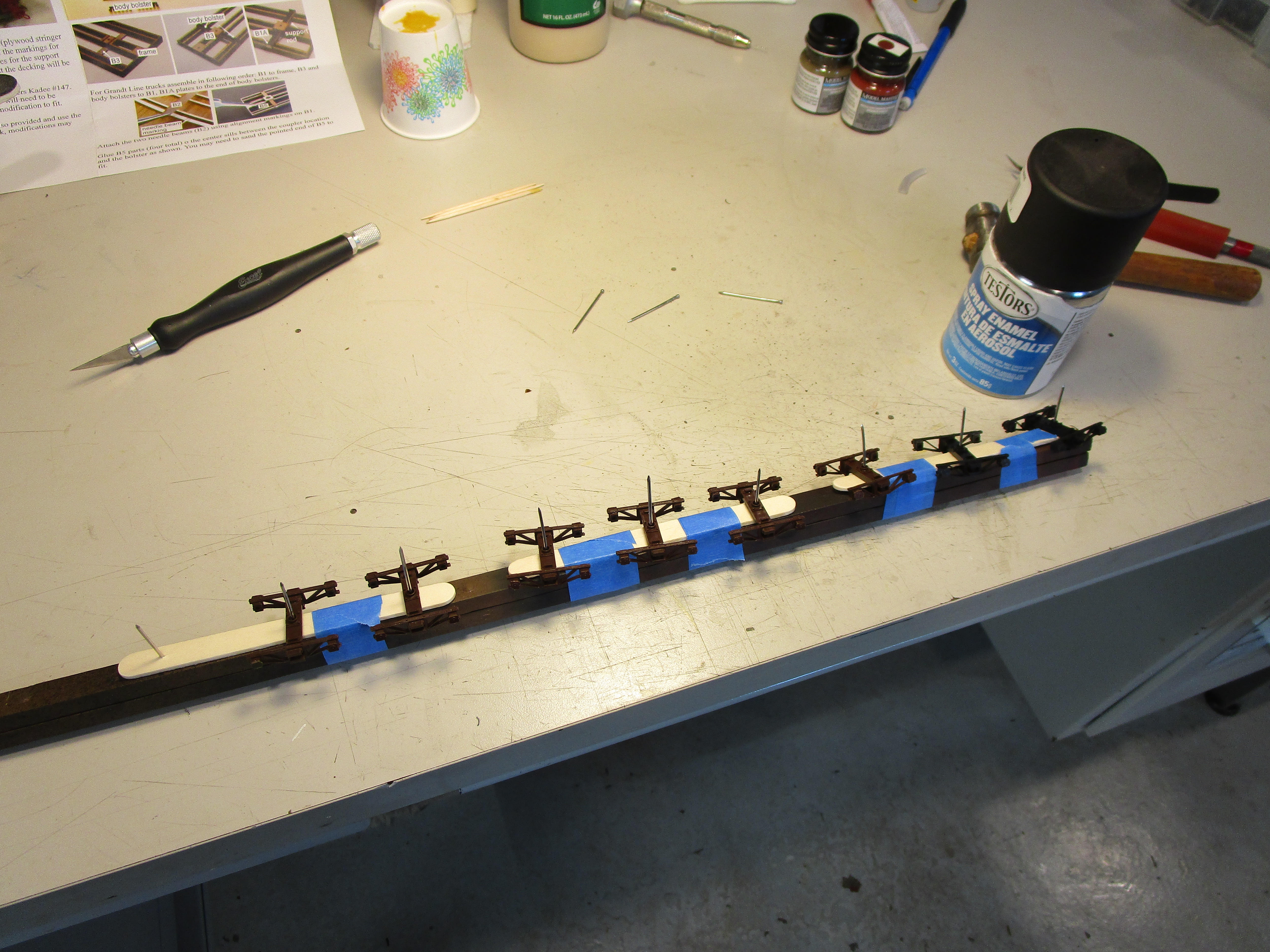
The wheels were painted in an old styrene jig I made up years ago. I painted four wheels a much brighter shade of orange than the rest so that the car I mount them in will look like it has newer wheel assemblies.

The frames have additional pieces of wood added to make up bolsters and coupler pocket support braces. I masked the truck bolster surfaces before painting so that the trucks would rotate cleanly.

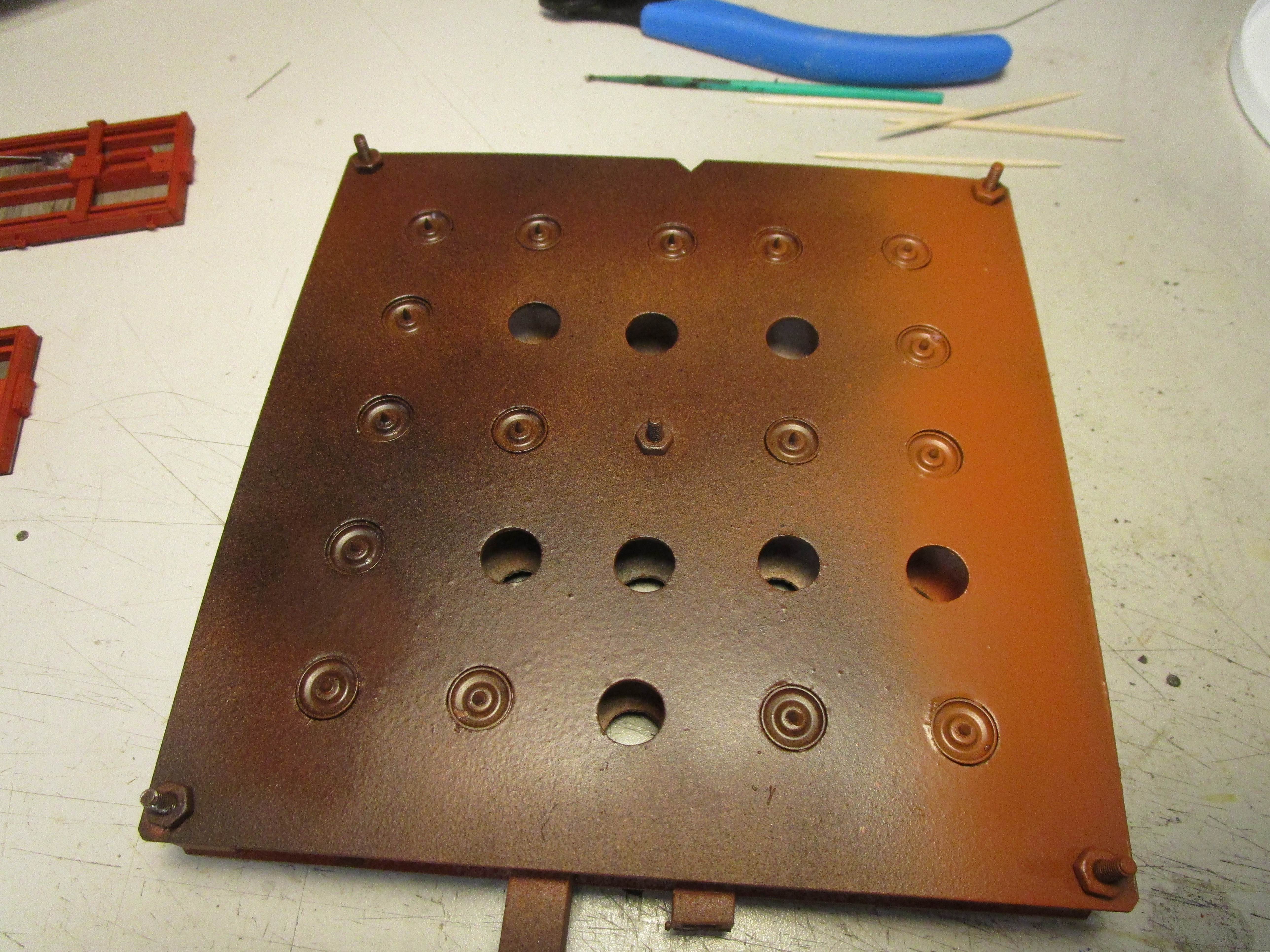
The frames were spray painted with Ace brand red paint. Ace uses nice paint nozzles and the spray comes out even and smooth. 
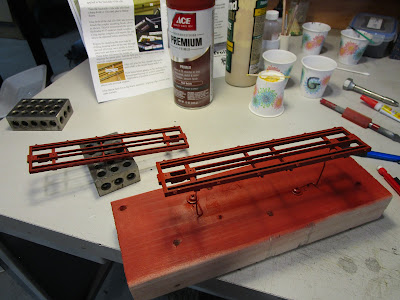
I later discovered that the trucks needed shims, and not having any Kadee fiber ones lying around I made my own from 0.005 thick clear styrene. Drill a hole in it, then punch around the hole with a paper punch. Easy, and cheap. Any size can be made if you vary the thickness of the styrene.

Then, the trucks and couplers were installed. You can also see my primitive efforts at bending and installing the truss rods. Additionala pieces of wire were included in the kit to simulate crossbraces but I omitted them for sanity's sake. This isn't a contest model.

Castings were included for the brake wheel and the mounting bracket, which consisted of a white metal casting. Though the instructions didn't say to, I drilled out one hole where a molded bolt was included and then installed the casting with a shortened track nail and superglue. This gave the assembly a little extra strength.

Decals were made for me by Precision Design Company. His prices are great, he was a pleasure to work with, and the turnaround time for this project was a day. Bill suggested using a font size and weight that matched drawings of the current cars, but I had him adjust it slightly so that the graphics looked better on the models I actually built (those two missing stake pockets really threw it all off). I am very happy with the results.

Then, I decided for kicks to weigh the near-finished model and discovered it was under 1 ounce per car! Now, I don't think the NMRA has recommended practices for On30 cars but an HO scale car of this length would be at least 4.5 ounces and this wasn't even close. I could add a load, but didn't want to be forced to. 

I talked to Train Troll and they recommended sheet lead, something that is hard to find nowadays. I bought some from Ebay and slipped strips of it underneath one car. Then, I flooded the gaps with Arleens' tacky glue, chosen over superglue because I didn't want the wood deck or sides to the glue and discolor. Even with the lead, it was only 2.2 ounces.. not even half of what it should be.

For the other car, I glued small wooden pieces to the underside of the deck between the frame pieces to make dams and then poured in lead shot. I then again flooded it with tacky glue. I made sure no round shot was visible from the sides and let it all cure up.

Once I was confident I wouldn't need to flip the cars over again, I added the brake wheels and shafts, along with the ratchet castings. They are now pretty delicate cars.

The kits came with wooden brake shoes and hanger parts, which I added to the one truck nearest the brake wheel (per the prototype). However, I couldn't get them to hang properly without being so low as to catch on trackwork details. 

There must be a trick to it, but adjusting them led to me mangling one set of brakes (seen between the cars) and I later removed the other set from the second car. I don't blame Train Troll for this... I blame my lack of skill in assembling them. So look out, these car's can't stop!

Flatcar #126 had the stake pockets painted black to match pictures I saw online. I also chiseled off the tiny n/b/w castings on the end of the car and replaced them with larger ones from my stash to better match prototype photos. If I had more on hand I would have done the other car. Oh well, I like the difference between the two flatcars.

The cars aren't finished yet. I still need to weather them and add some loads, but I don't know what I want to do with them. So, for right now they will sit in my display case.