CP Executive train in Albany

CP Executive train in Albany

Thursday, June 20, 2019

D&H's blue "Glass service" hoppers

I have always been fascinated by the D&H's blue hopper cars. So much so that in 2011 I went on an ambitious task to collect as much information about them as possible. The D&H Color Guide was a good start, but the D&H Yahoo online group and other online forums also provided snippets of info. I have also been watching Ebay over the years for slides of them, and various websites have images too. All images of prototype cars are from slides in my collection, and caption dates are based on the labeling. The information below is what I have been able to find, but like anything else involving something from 40+ years ago, take it for what it is worth. 

The image below of car #39022 (a "medium" car) was taken in October 1980.

The blue hoppers were part of a grassroots program between the City of Oneonta and the Corning Glass Works in Corning, NY. The hoppers would be spotted in Oneonta by the station on a recycling spur. Located nearby were 55-gallon drums which were filled with the color-sorted glass jars and bottles. At least one source indicated that the bottles were first broken before putting in the barrel, which might be to save space. When the barrels were full, they were then lifted and emptied into the hoppers. When the hoppers were fully loaded they would be hauled to Corning. There were originally three blue hopper cars, one each for clear, brown and green glass. 

Some of these cars lasted until the late 1980s in the blue scheme, though by then they had horribly faded (like most all of the other blue-dip engine paint schemes of the same era). It would appear that they were pressed into other revenue services besides the glass processing.

 However, it is proof that these cars still existed during the year 1984 that I model even though they likely never traveled on the Colonie Main.

There were at least three car body styles of hopper cars:

1.) Short 50-ton Fishbelly hoppers. These were built in 1944 by Bethlehem for the D&H (#6001-6100). Between 1939-1944, Bethlehem and SC&F built another 1,400 (#4701-6100). These were the first cars to be painted blue for this service. The road numbers I can verify are #4847#5812and #6067. A similar picture in the Color Guide shows that the last digit of the short car on the right is a "2", which means it isn't #6067. The cars in this program retained their existing numbers. There were two different lettering/paint variations. I have pictures of #6067 with a centered yellow vertical stripes and no end data, and pictures without the vertical yellow stripe but with end data. As far as I can tell, none of the other sizes of hoppers had this vertical yellow stripe.

The image of car #5812, a "short" car, was taken February 26, 1978. (See also here)


The image of car #32050 was taken in March 1989. Was this one of the original "Short" cars? Note the large yellow D&H shield added on one end and the City of Oneonta seal faded or painted out. By this time, it was likely in MOW service and its road number probably isn't the same as when it was used in glass service.


2.) Medium 55-ton double-bay hoppers. These were originally built in 1951-1952 and delivered by Bethlehem to the D&H (#6101-7100). There were at least three of these cars painted blue for glass service- road numbers: #7065, #39022, and #39058. Car #7065 was painted blue in 4/1979, but I don't know when the other cars were painted. The first car kept its original number, and as other more modern D&H hoppers received numbers in the #39000 series (perhaps their original numbers too?). Since they appeared together with the short cars it seems they supplemented rather than replaced them in service.

The image below taken on September 20, 1979 is of "medium" car #39058 in front of several "short" and "medium" cars including #4847 on the back left.  


3.) Long: 70-ton triple-bay hoppers. These were originally built in 1958 and delivered by Bethlehem to the D&H (#9000-9199). There is only know known car in glass service: road number #39041, which was painted in June of 1981 in a different, more spartan blue scheme with a white outlined shield and no City of Oneonta seal.

Post-Glass Service work:

Cars that were retired from glass service were pressed into other duties on the D&H. Here is a shot dated September 1982 showing at least two of the "short" cars being used for gravel service. Since the D&H was repainting all of its MOW equipment into the blue dip scheme in the late 1970s and early 1980s, using already-blue cars made a lot of sense.


Some of the cars lasted through the end of the 1980s, as evidenced by this image of faded car #39058 from December 1989. Additional blog post showing a photo of the cars after their glass service can be found here. Oddly, this was never painted for regular MOW service (the Oneonta emblem is still visible). 


Similar Recycling Programs
There is a tantalizing photograph in the excellent book Alcos Northeast by Mike Confalone and Joe Posik on page 126 showing two freshly painted blue D&H hoppers (whose numbers you can't see but they look to be the 55-ton medium cars) being pulled by a Vermont Railway red RS-3 on the Florence Job. It is dated 1976. I trust the date and the location, but am not sure why they would be in Vermont if the program operated between Oneonta and Corning. Perhaps there was another company in Vermont accepting recycled glass? Maybe someone familiar with Vermont Railways could comment.

Also, there was a program in Greenwich, NY, handled to some degree by the late David F. Nestle, who was a railroad author, historian, and teacher. He shipped outbound glass loads via the Greenwich and Johnsonville Railroad or the Batten Kill Railroad. However, they used D&H boxcars instead of the blue hoppers. I don't own Nestle's book about the G&J but I am told that there are pictures of the operation in it. 

Finally, the Cooperstown and Charlotte Valley Railroad based in Cooperstown, NY, also had a recycling program and shipping recycled goods. They used ex-Swift Premium reefers which were hand-painted to indicate the service. By chance I found this slide on EBay and snatched it up, as I am unaware of any published pictures showing these cars. The image below is from November 06, 1976 and was taken in Cooperstown.


Models of the D&H Blue Glass Hoppers
Painting your own cars wouldn't be difficult. It's just solid blue, which faded over time so you have a range of shades of blue. I actually purchased undecorated cars in two different appropriate body styles and painted one blue (using a spray can that was dead on perfect in color) but the corner steps were accidentally broken in a freak bathroom heat-bulb makeshift paint booth drying rack accident. I could have replaced the corners step but that ended my enthusiasm for the project. Then, Walthers and Atlas released some HO cars and I gave up painting my own.

Finding decals for special cars is sometimes difficult, but not here! In 2011 I worked with Ricky Rupp of Modern Rails custom decals by providing him pictures and information, and he produced the necessary artwork to make decals for me to do all three styles of cars. The Town of Oneonta's round city seal was especially well done. Decals for all three styles of cars are featured here on his website.

Part of the fun of these cars is loading them with real crushed glass! You can see some posts here and here showing how I did it.

There are many commercial models out there, no doubt because the blue cars are attractive and use car body styles that are common. Here is a list of the models that I am aware of. Most at least made some attempt beyond painting the car blue to trying to replicate one of the prototype cars. The first one to be released was by Life Like probably in the 1970s. All of the images of the models below were taken from the internet. I will update this list in the future as I find out more information, or as more are released.

N scale - Road #5987, 2-bay (Atlas #41251)


N scale - Road #6067, 2-bay (Atlas #41252)


Announced in the Atlas Winter 2025 catalog: #4827 (Atlas #50 007 213); #5802 (Atlas #50 007 214); and #5812 (Atlas #50 007 215).


N scale - Road #6067, 2-bay (Micro Trains #05600440)

N scale - Road #39041, 3-bay (Blueford Shops #14241 for single car)
N scale - Road #39043 & #39049, 3-bay (Blueford Shops #14242 for 2-pack)

HO scale - Road #5812, 2-bay (Life Like # 08504)


HO scale - Road #7065, 4-bay (Walthers Trainline #931-1420)

HO scale - Road #7065, 2-bay (Atlas #1832-1, only part of Limited Edition set)


* I have also seen references to a 3-pack of custom painted HO scale hoppers which used Athearn models and were painted by Third Rail Graphics. They featured blue with yellow lettering including the City of Oneonta's city seal and had at least two road numbers. 

O scale - Road #5998, 2-bay (Atlas #3007102)

O scale - Road #6146, #6135, #6157, #6132, #6138, 3-bay (Weaver #_____?)


O scale - Road #6075, #6073 (MTH #20-97303)

Putting together this post took hours of digging through old resources, checking websites, and flipping through books. I enjoyed it, and hope others will benefit from thei information.

If you have any additional information or images to share regarding anything listed here, please feel free to reach out to me and I will update this page.

Saturday, June 15, 2019

Switch brooms on the Colonie Main

Last fall C.P. started to clean up the right of way along the line between Kenwood Yard and North Menands. They might have been working on other portions too, but that is just what I observed on my daily commute. This included cleaning up the ditches and grooming the ballast and removing overgrown brush around the Surpass sidings. I assumed it was just part of overdue maintenance. Then, in last October the C.P. Executive Train came to Albany and journeyed over that portion of the line. Within days, rumors of C.P. potentially selling this portion of their American trackage were on the internet and the pieces started to fall into place.

Switch to Surpass.
Then we had winter, and I didn't think much more of it. However, in either late April or early May I was driving along the road by the tracks and I saw something interesting. They had just installed bright yellow piping with brooms sticking up! This is, I assume, to aid in clearing out switch points of ballast or dirt (and perhaps snow, though it was a little too late in the season for that). These switches are used somewhat frequently and having a broom here makes sense. It also seems quite ripe for someone walking buy to steal. I don't know how long they will last, and/or if C.P. is installing them on other portions of their railroad, but for those who model the modern scene it is an interesting detail.

Tuesday, June 11, 2019

Adirondack Live Steamers - Spring Meet 2019

This past weekend the Adirondack Live Steamers in upstate, New York (Saratoga Springs) held their annual Spring Meet. Like nearly all other live steam clubs in the northeast, this one was open for visitors to bring their trains to run on our track. Our track gauge is 7.25", which is also used in parts of Canada and Europe, and trains are mostly 1/8 scale though some trains based on narrow gauge prototypes scale out to roughly 1/3 or 1/4. (Much like On30 models use HO scale track). They make for large trains which are not just ridden on, they are ridden in. My own narrow gauge steam locomotive under construction is 1' = 3.75" scale.

Our club engine... members are allowed to run it with training.
I joined ALS in 2006 after picking up a couple of issues of Live Steam & Outdoor Railroading magazine in a local hobby shop on a whim. I had visited a live steam club in Western NY when I was a child (they are celebrating their 50th Anniversary this August, but that is a subject of a future post) and I wasn't totally ignorant to the hobby. Still, I wasn't sure if this club was for me. Having moved to Albany in 2004 I looked around for clubs and finally sent emails to ALS and the local N-Trak club. ALS responded first, so I visited and joined, and the rest is history. I finally stepped down as Treasurer after 9 years on the Board of Directors, so this was also my first meet where I didn't have to count money, write checks, etc. I could just sit on a bench, watch trains, smell coal smoke, and have a good time.

The inside cab view of a working steam locomotive.
While we usually have a good turnout (no pun intended), the weather was absolutely gorgeous for all three days of the weekend and that is something that I can't recall being true since I have been a member. We let mostly visitors run their trains during the weekend, and they love to come to our club as our track is much larger than other 7.25" gauge tracks in the northeast (nearly 1.5 miles in mainline along), with lots of grades, curves, bridges, tunnels, water features, and road crossings. It is not a railroad you can just set your throttle to "go" and kick your feet up. For an even greater challenge, some days we reverse direction and it creates essentially a new railroad to learn.

What do you do when your train is too long for a single engine to pull? The real railroads would just add more engines, either in the front or the back or perhaps mid-train. The exact same thing is done in smaller scales, though I think we modelers usually do it just for the operational challenge of controlling two motors. Here, while five passenger coaches isn't a difficult load for this LMS pacific on flat track, I heard that the throttle was a bit touchy and it would spin its wheels instead of getting traction at the bottom of our grades. This might be true, but whatever the reason it was necessary for the engine to get an assist over the main line. 

So, the club's very own steam locomotive (0-4-0) was pressed into service and played the role of "banker" and ran with the train along the way. Even with only four wheels, it worked admirably. I think I can, I think I can...


The owner of the large LMS pacific also owns at least two other British steam locomotives: one is a GMR "King Class" (with 4 cylinders and thus twice as much fun adjusting the valve gear) and a chunky 0-6-0 narrow gauge tank engine. This one is built to a narrow gauge scale and thus it is large enough to ride in, not on. And it is a great puller. It easily handled those five coaches above loaded with passengers round after round. It is named "Thomas", perhaps in deference to the other tank engine going by that name. That isn't the owner in the cab but someone who frequently operates the engine when it visits the club. That tender looks mighty comfy.


This is an "Allen Models" locomotives. Allen Models is a manufacturer of locomotive castings for about a half-dozen different styles of locomotives. While no live steam engine project is considered easy, these engines are simple to build and very dependable to run. Lots of people use their castings to build running engines, and this ten wheeler is one of about 5 Allen Models-based engines at ALS. I happen to have the prints for the mogul (2-6-0), of which there are hundreds running across the USA. Someday, if I get my own shop, I may pursue building one of those as I really like the way they look and it is a very user friendly engine. 

This engine was designed and built by one of our founding members using a combination of Allen Models castings, some other manufacturer's parts, and a lot of thinking and building from solid chunks of metal. He essentially took the frame from a locomotive based on a small narrow gauge plantation locomotive (0-4-2) and stretched and reconfigured it to look more like a Colorado based steamer. While I think he did a great job, even those who don't understand what his background or thought considerations were would be hard-pressed not to call it attractive or "cute." The railroad on the tender, "Fitchburg Northern," is also the name of his HO layout.

For those who think that Athearn was the only company building diesel locomotive kits, here is a shell for an SD-40 from the Railroad Supply Company. It is cast in fiberglass and has several add-on pieces at the top depending on whether the builder wants dynamic brakes or not. Unlike in HO scale, switching that around would be a major undertaking here. Windows still need to be cut out, but most of the other details are molded in place or are added separately like a super-detailing project. Then, it needs to be painted and for jobs like this automotive paint sprayers and epoxy paint are good choices for durability.

And what to put under that shell to run it? Here are the guts: it is a 48 volt system that runs off of four deep-cycle batteries (don't get regular batteries which are designed to be discharged a little over time- we need deep cycle batteries that can get drained down to zero and repeatedly recharged) and special control packages to control the motors. Two of the axles on each truck are connected to the gearbox, the remaining two axles are connected to the rest by chains and sprockets. You can also see the handrails are in place. All in all, it is a powerful engine.

That isn't a guy hanging out the bottom. He is working on the
ground on the next engine over. It looks funny though!
One last picture here is of importance. This engine shell has been painted blue for as long as I can remember, perhaps 10+ years. It had no decals or graphics and was starting to get a little shabby and rusty. But, the owner retouched the black paint and unveiled the engine this weekend with Conrail graphics. The slight rust in the cracks and other areas looks like perfect "weathering." But what is so special about this engine? It is painted in actual Conrail blue, obtained from the railroad's engine department. When I said to my friend it might be the last existing engine in genuine "Conrail blue" paint he responded with "Don't forget Conrail Shared Assets engines." Grr, he might be right!

Here is one last picture of our roundhouse area. You can see some of the engines are being steamed up, some are being blown down, and some are being cleaned. All of it is work. Filthy work. No one said that owning an operating steam locomotive was easy. But it is this work that makes the running so much more enjoyable. Those of you who have ever operated a live steam locomotive before (like a Gauge 1 engine) can relate. Except these guys are 100x the work and 100x the pleasure when things go right. And when they don't... oh well... then you get to fixin' them.

If any of you are around in the fall, our Fall meet is the second weekend of September. Feel free to check out our website.

Sunday, June 9, 2019

Roster Review: D&H high-nose RS11s in 1984

(November 03, 1984)
My research on the D&H's roster in 1984 is constantly evolving but there are times when I think I have a pretty good handle on it. Take their Alco RS11 engines, for instance. I love high-nose units. My first train set had an Erie Lackawanna high-nose GP50 by Bachmann. Not very prototypical, but I loved it and didn't know any better. I would usually run it long-nose forward for some reason (pulling my silver Amtrak cars which seemed a good color match), and when you do that high-nose units don't look as strange as with low-nose ones. So, I first focused my roster on the D&H high-nose RS11s.

(November 03, 1984)
The six high-nose units were originally built and delivered to the New York Central (#8009-8014) in March 1960, but they were never accepted by the NYC. Apparently, the NYC had made a verbal commitment to Alco but after delivery NYC management could not get the authority to pay for them. So, they were sent back and in January of 1961 they were sold to the D&H. Later purchases of Alco RS11 engines had short noses, which the D&H preferred. In 1973, the #5004 was involved in an accident and during repairs its nose hood was replaced with a cut-down tall hood. Since in 1984 it wasn't a high-nose engine and would require some kitbashing to model, I am disregarding it for now.

(August 21, 1984)
I own three models in HO scale already but hope to have every one of their high-nose units someday. It shouldn't be too tough, as there were only six (#5000-5005) and Atlas has been doing an excellent job of releasing them in HO and N scales. The three I own (#5001, #5002, #5005) all came in the correct factory paint and with DCC and sound; two are weathered so far. Once thing I didn't do was dent the corner of the short hood of #5002 as can be seen in the picture, though that would have made for an interesting detail. However, the other weathering patterns were copied from pictures.

(sometime in 1984)
The #5000 should be an easy one to model, as several different manufacturers have offered it over the years. It is available from Atlas with large numbers and that matches what the engine had through at least November 1983. Slides from 1984 shows the engine with the words "Delaware & Hudson" and small numbers on the hood that are in very good shape, which would indicate that it was probably repainted sometime in late 1983 or early 1984. However, you can see ghost images of the large numbers above the word "Hudson" on the side of the hood. Either the new paint over the large "5000" was applied so poorly that it wore off in a matter of months, or else the D&H didn't even bother to paint over it when they added the "Delaware & Hudson" lettering and small numbers to the engine.

(August 16, 1984)
Atlas also sold a factory painted #5000 with road name and no numbers, which could be useful as long as I added decals (small numbers below the lettering, and blotchy large numbers above it) to match the pictures I have. Finally, Like Like P2K offered an engine with small the lettering and small numbers, and I could save a step and just add the ghosting large numbers above the lettering. I suppose it is better to have lots of options than no options. But, I am still on the hunt for more information and until I find out what it looked like on both sides in May of 1984 I will wait. 

(August 26, 1984)
That only leaves one other high-nose engine, the #5003. While for years I thought that the yellow nosed #5001 was my favorite D&H engine, my opinions have changed and I think I like this one better. There is something about the yellow chevrons that is really classy. So far, no manufacturer has offered a model of the engine in this paint scheme, and I would be surprised if someone ever did. Most modelers don't focus on the 1980s. There are pictures online from 1983 showing on the engineer's side extensive fading and the gray from the earlier lightning stripe coming through, and another from 1985 showing the fireman's side still dark blue with little fading. Did the engine fade on only one side? Did they repaint it sometime between '83 and '85? Is one of the pictures dated incorrectly? The model will likely need to be custom painted, but until I figure out its correct appearance on both sides I will continue to search for more information. 

(March 1986)
Some might question why I would want six of the same engines for such a small layout as mine, but the answer isn't easy. Unlike some railroads that owned dozens of the same diesel engines (and where they all looked the same), the six RS11 engines in 1984 carried what looked like five different paint schemes. Any and all of them would frequently find themselves running on the Colonie Main, so their appearance on my layout wouldn't be unusual. And, it is sort of like collecting baseball cards (or Pokemon) I guess. I gotta catch them all!

(December 1987)
Part of getting the models ready for my layout is to weather them. And I don't own an airbrush, and I don't feel comfortable using spray cans on expensive engines, so I have Elgin Car Shops do it for me. Frankly, if you don't weather an Alco engine it won't look realistic! Before I send any of my engines to him, I look for pictures of what they looked like in 1984. Because the D&H occasionally repainted or washed its engines, the weathering would change on the same engine over the years. And while weathering patterns seemed consistent within the same class of engine, little subtle differences jump out.

Wednesday, June 5, 2019

Leaning engines in Mechanicville

March 8, 1981
#761: "Psst, guess what? I got a secret I want to tell you."
#7613: "Ooh, I love secrets! What is it?"
#761: "Shh, get closer. I don't want the others to hear it."
#7613: "Okay, how about this?"
#761: "No, even more, this is top secret and just going to be between us."
#7613: "I understand you, but I'm leaning as far as I can!"
#761: "That's better. Did you hear about what's going on in Colonie ... "

The slide shown here has been on EBay for a couple of weeks now. For some reason, whenever I saw it the above conversation would take place in my head and make me smile. Simple minds... I guess. I finally had to buy the slide and put an end to the silliness!

It also shows that engine house track in Mechanicville probably could have used a little leveling and tamping.

Wednesday, May 29, 2019

Trip to Baltimore

My birthday typically falls around Memorial Day weekend. This is very convenient for me, as the long weekend usually provides an extra day to schedule day trips to visit various train museums or tourist railroads in celebration of my birthday. Past recent excursions have been to the Arcade and Attica Railroad in 2015, the Berkshire Scenic Railway Museum in 2016, the 2-Foot gauge trains in Maine in 2017, and the Essex Steam Train in 2018. This year, I decided to plan a trip to visit the B & O Railroad Museum and the city of Baltimore.

This wasn't the first time I had been to the museum; when I was younger, my father took me here while visiting my Uncle who lives in DC. But, it had been over 20 years since my other visit and I think 15 years since the terrible snow storm caused part of the roundhouse roof to collapse. I thought it would make for a great trip, and the ability to take in the railroad exhibits through older and much more informed "adult" eyes was an opportunity not to be missed. So, I booked a hotel over the winter and started planning things to do that would appeal to both myself and my wife.

Though the name of the museum implies that the focus of the exhibits would be on the B&O (and all its successor railroads), in reality it is much more than that. The B&O was there at the very beginning. It is the oldest railroad in the USA, which means studying the B&O is studying the development of railroads and history of railroading in America. Inside its roundhouse are perhaps twenty old or recreated steam locomotives from the very basic four-wheeled "Tom Thumb" types to the "Americans" and ten-wheelers that won the west. Each is beautifully preserved with colorful (gaudy?) paint schemes that demonstrate the pride that existed at the time. As I explained to my wife, it is comparable to car enthusiasts who paint racing stripes or flames on their autos today. I really like these older engines, and have a couple in HO scale. I even flirted with building one in 1/8 scale but the grades at my local live steam club would have severely limited its potential.

Elsewhere outside are other pieces of railroad equipment in various stages of decay. Some look pretty good, but some are faded and rusty. Not everything can be kept indoors and the museum has made it a priority to store their best pieces under cover. As such, while the cranes, boxcars, and diesel engines outside are nice to see I didn't spend a lot of time on them. I will note that they occasionally rotate their equipment as when I was younger they had a C&O streamlined steam engine as the corner piece of the outside area. Now, the steamer is inside under cover and this Geep is in its place. Without shade and protection from the elements, it will soon too lose its luster. But, even these pieces are interesting.

The museum also has several seasonal or rotating exhibits, and this Memorial Day the focus was on trains of World War I. We arrived I think on the first day it was open. Admittedly, I didn't find it very interesting as it related to the railroad efforts domestically but the portions of the exhibit that discussed foreign railroad construction were fascinating. I was glad to see a diorama built by fine modeler Bernard Kempinski, whose United States Military Railroad blog I follow. He published a book about modeling war trains which I hope to purchase, and this diorama was probably built for that book. My wife thought the backdrop painting scenes were really well done. I liked how it didn't seem like a forced diorama because of all the open space captured in the scene.

Also on display was one of the French "Forty and Eight" cars, (which is somewhat visible on the upper right placard. Per Wikipedia: "Forty-and-eights were French 4-wheel covered goods wagons designed to hold 40 men or eight horses. In 1949, France sent 49 Forty-and-eights to the United States laden with donations from citizens of France in thanks for the U.S.' role in the liberation of France, one for each of the then forty-eight states and one for Washington D.C. and Hawaii to share. Called the Merci Train, it was sent in response to the Friendship Train America had created two years earlier to aid France in the dire immediate aftermath of World War II. Over 700 boxcars worth of donated supplies were collected across the U.S. and shipped across the Atlantic via donated transport." Of interest, we saw another car in Maine two years ago at the Boothbay Railway Village which I assume was Maine's surviving car. This car was on display here for the first day, and there were lots of volunteers on hand who had helped with its restoration.

Our Train Ride's motive power
One optional add-on at the museum is a train ride. It is essentially a push-pull ride down the spur that connects the museum to the active CSX tracks. The ride is in restored B&O coaches, or for an extra fare you can ride in the observation car and receive complimentary snacks and drinks (chips and soda, basically). You don't have to think hard on which option I picked! We got the two seats closest to the observation end (a group of old ladies who got in first picked some tables by the kitchen area... fools) so we had a great view. As to that view, we saw abandoned stores, run down strip malls, a metal scrap yard, a police horse barracks under construction, and the B&O restoration shop's exterior. The mystique of the train didn't match the Glacier Express but hey... it was a train ride! We saw with two people, one of which sounded a lot like Peyton Manning. I could have listened to him talk for hours. The other guy had done some contract work for the A&A. You just couldn't pick two better companions (besides my wife, of course).

Outside, they had other things for the kiddies like a carousel, some train rides, and a nice garden railway. I liked how it was elevated on a raised bed formed from pressure treated wood. I hope to have a simple garden railway in my backyard someday, also raised up, though with stone or brick wall construction. Some of the trains just rumbled on their own merry way, but others didn't move until you pushed buttons on the outside of the garden's fence. Most of the trains again were decorated for the B&O or its successor railroads. It was well done, though stuff was starting to fade here too. The southern sun and heat... ugh. 

After we left the museum, we walked to the harbor. Our destination was the National Aquarium which is located in the inner harbor, as are various historic ships such as the U.S.S. Constellation (the largest and last sail-only ship in the U.S. Navy. There was also a submarine, the U.S.S. Tursk, which I think I went in with my father when we visited here years ago. There were also paddle boat rentals, which include some that were shaped like dragons and others that were larger and decorated like pirate ships. There were even larger pirate ships that you could pay to ride around in. In a battle I am not sure I would bet on team sub/warship or team dragon/pirate ship. But, it was a hot day and everyone seemed to be having a good time.

Outside our hotel (which was located right next to the Orioles' Camden Yards) was a light rail line. Unfortunately, the Orioles were away the weekend we were there or I would have gone to see my favorite baseball team in action. If I had more time to explore, I would have researched where it went and how much it cost to ride it. Just getting on and taking it to the end would have been fun. I did that once with my father on the Boston MTA's Green Line, and it was a good way to see the city. The light rail cars have their own traffic signals to follow when they cross major roads, though I don't know what happens when a car is stuck blocking the track. I suppose a gentle push to help it along wouldn't be out of place.

The next day we went to the Maryland Zoo, and I saw some interesting birds that I had never seen before. They had net-enclosed areas where you could go in and the birds were within only a couple of feet of you. One swooped down in flight and I thought it was going to take out my wife. We also saw pink flamingos (did you know that they really exist? I thought they were just goofy decorations at trailer parks) and penguins. I have a fascination with penguins, especially the African ones that you can observe without being in Antarctica (which I probably will never get to in my life, in no small part because there aren't train rides there).

At one of the zoo's food vendors I purchased some Dippin' Dots ice cream. I had seen signs for it but never purchased it before. This place had six flavors including cookies and cream (and some colored specks that must have been stuck to the spoon from another flavor) with real Oreo pieces. Though they are the "ice cream of the future," it was introduced in 1988 so it over 30 years old now. It was an odd thing to eat, and I wouldn't be surprised if it takes another 30 years before I try it again. It is like eating those Nerds candy, except that it sometimes melts and sometimes just makes your head cold. Very strange.

The zoo had a train. I had to ride it. The train skirts the edge of the zoo and appears to be an afterthought, though hopefully the zoo will expand around it so that you can see more. I think it was 16" gauge, but I can't be sure. It is a Chance brand train, modeled after the C.P.R.R.'s "C.P. Huntington," though sadly the large single wheels on each side had been removed. While talking with the operator, she said that those non-functional wheels sometimes caused the train to derail so they were taken off. I originally didn't hear the train while we were there so I feared it was closed, but I finally heard the screech of metal and knew it had to be close. It looked really nice and later I had a chance to ride it.

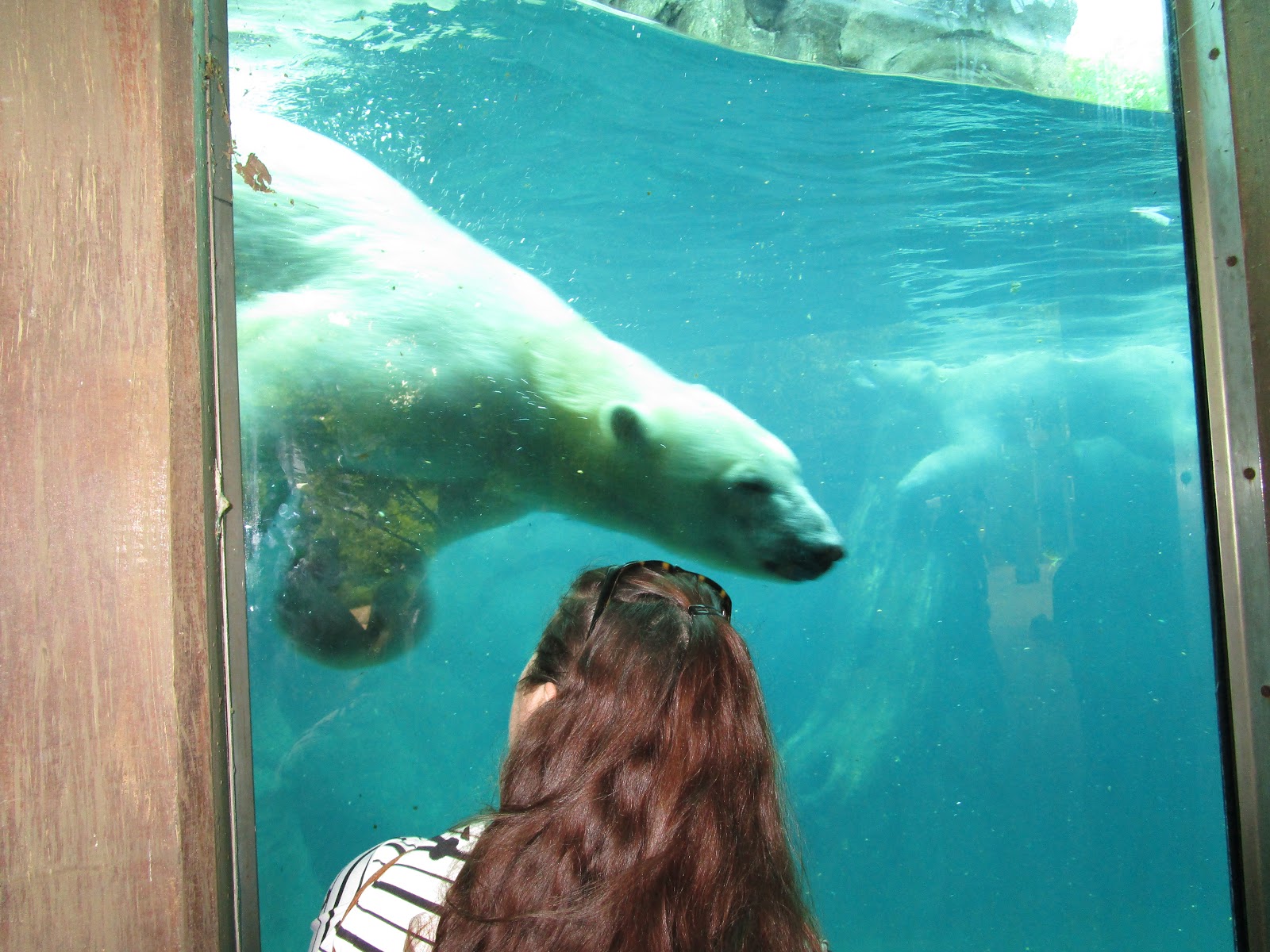
I love polar bears, and they were having a blast swimming in the pool at the zoo. And why shouldn't they? It was over 90 degrees outside and humid. Much of the afternoon was overcast which helped, but at times it was really hot. I remember the heat and humidity for sure from my trips to D.C. I had purchased a new camera for the trip, as my old Kodak's battery wouldn't hold a charge, and a real test came in trying to shoot a moving polar bear behind glass underwater in a poorly lit area. I think it did okay, and here I think it is trying to kiss my wife. I am going to keep my eye on him in the future.
It was a great trip. I had fun. I saw a railroad museum, rode on two different trains, saw dozens of trains in and around Baltimore and on our drive down, and had light-rail pass right near our hotel. I am sadly one year older, and the gray hair has started (my wife lovingly refers to it as "silver"... bless her heart). But, as trips go it was one of my favorites.

Wednesday, May 8, 2019

Then and Now: passing through Cohoes

Here is a slide I recently purchased. It is dated March 1984, which is just 2 months before my layout's time frame. The train is heading south and it just about to cross Spring Street in Cohoes. It is on the mainline, and the track to the right of it is a passing siding (once probably part of the double track all the way from Kenwood Yard up through Watervliet). It was retained here I think so that the locals could do a runaround move for freight cars destined for Mohawk Paper, which is the track on the very right. Right before spring street is breaks to the right and crosses in the middle of an intersection (see here). I can't imagine what it was like to look out the windows and see the D&H just 50 feet away!

This passing siding currently was disconnected on the southern end, so it is just a spur, as seen on this Google maps image. However, on my layout it serves as the only passing siding available. All the trees along the ROW are blocking the views of the houses, and the houses that match with the upper picture are blocked by the foliage. As an aside, when my wife and I were house-hunting we considered walking through one of the house next door to this one pictured. It was priced significantly less than similar houses elsewhere, and I assume it was because of its proximity to the tracks. But, we decided to pass.
Monday, May 6, 2019

Loading MOW equipment on flatbed truck

I was in Arcade, NY last week for a stockholder's meeting for the A&A Railroad. As I was driving through Java I saw down along the tracks a little yellow truck. I thought perhaps it was parked, but as I pulled over and watched it I noticed it was slowly moving away from me. I turned around and drove to another road crossing and saw it drive through, doing what looked like 5MPH at most. There were two people riding it and I wondered if they were doing some track inspection. I don't know if I have ever seen it before, but likely I have and took pictures of it. It would make for an interesting modeling project, what with the welding and all the other tools and supplies loaded on it.

The A&A received a State grant last year and has been hard at work using it to refurbish the line north from Curriers to North Java. That involved a lot of track MOW equipment. As I drove into the Town of Arcade I noticed some of it was parked alongside the firehouse. And one of the pieces was being prepared for loading onto a truck. Having never seen this before, and with a couple of minutes to spare, I pulled over and took some pictures. It was quite interesting actually. The pictures tell the story, and within about 5 minutes it was on the truck. I couldn't stay to see the end of the process and how far they shifted forward the MOW unit. It was physically pulled onto the trailer via a chain and hook, much like a tow truck.


Friday, April 26, 2019

Call in the crane train! (1979)


In November 1979, the D&H had to call for the wreck train. This shot shows the train in Rotterdam heading South. No idea what the need was based on, but I thought it made a nice shot. I plan to model the MOW train in the future, but by then nearly everything was just blue instead of this snazzy blue/gray/yellow scheme.


Monday, April 8, 2019

New Toys (and disappointments) - Dremel accessories!

Though I haven't touched it in several weeks, my excuse for the lack of progress on my D&H bobber caboose has been that I have to drill some holes for marker light brackets. Those holes have to be small, and they have to be accurate. I recently bought a new pin vice, but I wanted to try my hand at using a Dremel 200 series motor tool to drill small holes. This requires two things: a #4486 keyless chuck (to hold the drill bits) and a speed controller (to slow down the RPMs so that you actually drill the plastic before the bit snaps and flies off to wherever. I purchased the chuck on EBay. BE WARNED: there are many Chinese knockoffs also on EBay under the same listing. I assume the Dremel plastic clam shell packaging means mine is authentic. I looked at foot switches, but then at a recent train show I found this.

Unfortunately, I then contacted Dremel to confirm that they were safe to use together and they responded that they were not compatible. Since both the Dremel and the speed control contain rheostats, they will "work against each other and burn out the motors." To use the speed control, I need to purchase a 100-series Dremel tool. LAME!

So, I might just try the chuck and the slow setting on my Dremel 200-series and see what happens. If anyone is interested in the speed control, I will give you a good deal on it!